• Zur Metanavigation
  • Zur Hauptnavigation
  • Zur Suche
  • Zum Inhalt
  • Zur Subnavigation
  • Zum Seitenfuß
  • University of Hamburg
  • For journalists
  • Staff Service Portal0
  • STiNE
https://www.kus.uni-hamburg.de/aktuelles.json?recentnews=true
  • Institutions and target groups
    • Einrichtungen
      • Faculties

        • Faculty of Law
        • Faculty of Business, Economics and Social Sciences
        • Faculty of Medicine
        • Faculty of Education
        • Faculty of Humanities
        • Faculty of Mathematics, Informatics and Natural Sciences
        • Faculty of Psychology and Human Movement Science
        • University of Hamburg Business School
      • Services

        • Study Information Net STiNE
        • Surfmail
        • Exchange
        • Staff Service Portal
        • Learning Platforms
        • Katalogplus – Catalogue of Hamburg Libraries
        • SharePoint
      • Student facilities and services

        • Campus Center
        • Career Center
        • PIASTA
        • AStA (student council)
        • University Sports
        • University Music
        • Family Office
        • University Language Center
        • General Languages
        • Office of Affairs for Students with Disabilities or Chronic Diseases
        • Departmental libraries
        • Healthy Campus
      • Further facilities and services

        • The Cluster of Excellence CLICCS
        • The Cluster of Excellence CUI
        • The Cluster of Excellence Quantum Universe
        • The Cluster of Excellence Understanding Written Artefacts
        • Hamburg Research Academy
        • Pier Plus
        • Hamburg Center for University Teaching and Learning (HUL)
        • Hub for Crossdisciplinary Learning (HCL)
        • CEN
        • Museums and collections
        • University Archives (in German)
        • Regional Computing Center (RRZ)
        • University Administration
        • Knowledge Exchange Agency
        • The Unikontor Shop (in German)
    • Target groups

      • Prospective students
      • Students
      • International prospective students
      • Young researchers
      • Researchers
      • Instructors
      • Staff
      • Prospective continuing education students
      • Alumni
      • Journalists
      • Refugees (in German only)
    Close
  • /sitemap.json
University of Hamburg - to research, to teach, to educate and form, to homepage

Beta maṣāḥǝft

Beta maṣāḥǝftManuscripts of Ethiopia and Eritrea
  • About the project
    • Background
    • The Ethiopic language
    • Current situation
    • Partners
  • Manuscripts
    • Codicology
    • Palaeography
    • Scribes
    • Manuscript collections
    • New research
  • Literature
    • Clavis Aethiopica
    • Authors
    • Genres
    • Paratexts, guest texts, colophons
  • Publications
    • Publications
    • Catalogues
  • Our team
    • Current team
    • Former team members
    • Cooperation partners
  • News

Photo: Ethio-SPaRe

  1. UHH
  2. Humanities
  3. AAI
  4. Beta maṣāḥǝft
  5. Manuscripts
  6. Palaeography

Palaeography

A clearly defined Ethiopic script first appears in inscriptions from the second/third centuries CE. By the fourth century, the system of vocalization has developed. It is the same script as is used in Ge'ez manuscripts - and as has been adopted, with few modifications and additions, by the modern Ethiopian Semitic languages (Amharic, Tigrinya, Tigre).

The letter shapes, while clearly resembling their South Arabian percursers, were from the very beginning more rounded, even more so after the adjustment of the script from epigraphic documents to handwritten forms. Still, the so-called 'monumental' script of the earlier manuscripts (from the fourth/sixth century, the earliest suggested date for the extant witnesses, to the fourteenth century) is strongly reminiscent of inscriptions.
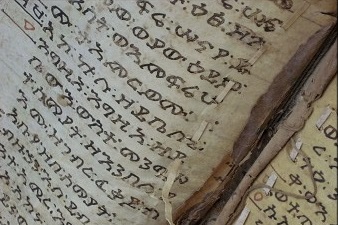
The script has remained relatively stable ever since. It has remained a purely majuscule (uncial) script. There is no cursive, and such characteristic features as monograms or abbreviations are hardly ever used. The decorated initial, common in European manuscript tradition, is also absent.

A rough chronology of its development has been suggested, and palaeographic observations have been used by most cataloguers of Ethiopic manuscripts; yet, the differences between the periods are sometimes so slight, and regional and individual variability within (even for one of the same hand) is so great, that more research would be necessary for the palaeographic descriptions to become a reliable tool for dating and placing manuscripts.

A comprehensive electronic catalogue of the project shall be a first step towards a reliable palaeographic database.


  • Manuscripts

  • Codicology
  • Palaeography
    • Scribes
    • Manuscript collections
    • New research

    Contact

    Scientific Director

    Alessandro Bausi

    Administrative Director

    Eugenia Sokolinski

    Email

    aethiopistik@uni-hamburg.de(aethiopistik"AT"uni-hamburg.de.)

    Last update: 10 May 2017

    • Feedback
    • Legal notice
    • Privacy statement
    • Accessibility
    • Site map

    University of Hamburg

    Innovating and Cooperating for a Sustainable Future in a Digital Age

    • Follow us on Instagram.
    • Follow us on Facebook.
    • Connect with us on LinkedIn.
    • Follow us on Mastodon.
    • Follow us on Bluesky.
    • Subscribe to our channel on YouTube.
      • Studies
      • Prospective students
      • Continuing education
      • Research
      • Teaching at UHH
      • Doctoral studies
      • Job opportunities
      • Knowledge exchange
      • University
      • Excellence
      • Faculties
      • Alumni
      • Contact
      • Campus Navigator
      • UHHApp
      • Emergencies, safety and security
      • Antidiscrimination
    Go to family-friendly higher education institution audit
    Go to internationalisation re-audit
    Go to the Sustainability Audit page
    Go to Diversity Audit
    Go to System accreditation

    © 2026 University of Hamburg. All rights reserved